
Views: 0 Author: Site Editor Publish Time: 2026-08-28 Origin: Site


Handling slag presents some of the most unforgiving environments in the industrial world. Operations face extreme temperature spikes, punishing impact forces, and aggressive abrasion on a daily basis. When components fail under these harsh conditions, the consequences are severe. Unplanned belt failures lead to catastrophic downtime. They also create immediate safety hazards and inflate maintenance budgets rapidly. Facilities cannot afford to treat these conveying systems as afterthoughts.
This article evaluates the specific materials designed to survive these environments. Our goal is to provide a clear, objective framework. You will learn how to match belt properties to your exact operational thresholds. We will explore everything from specialized rubber compounds to metallic apron designs. By understanding these options, you can specify the right materials for a High Performance Slag Conveyor. Ultimately, you will gain the insights needed to eliminate recurring failures, improve site safety, and keep production moving seamlessly.
Belt selection must prioritize peak temperature resistance, tensile strength, and abrasion resistance over initial purchase price.
Standard rubber belting will rapidly fail in slag applications; specialized EPDM, steel cord, Aramid (Kevlar), or metallic apron designs are mandatory.
Specifying a belt requires auditing current failure points—specifically whether the belt fails from heat degradation, mechanical puncture, or chemical wear.
Slag handling destroys standard equipment quickly. You must understand the exact forces at play before specifying a Slag Conveyor. It is not enough to simply ask for a "heavy-duty" option. Let us break down the core challenges present in these aggressive environments.
Operating temperatures tell only half the story. You must differentiate between continuous heat and localized spikes. A belt might run continuously at a manageable 400°F (200°C). However, a sudden load of red-hot, insufficiently cooled slag can introduce localized spikes exceeding 800°F. These isolated thermal shocks bake the rubber instantly. They strip away essential plasticizers from the compound. This causes rapid surface hardening, deep transverse cracks, and ultimately, premature failure.
Bulk slag is incredibly heavy and highly abrasive. It acts like jagged glass mixed with dense boulders. When slag drops onto the belt at the loading zone, it places immense mechanical stress on the top covers. The extreme impact forces can easily puncture standard fabric carcasses. Once the inner fabric tears, the entire belt structure becomes compromised. Furthermore, high-velocity loading zones accelerate this wear. The rough edges scrape the top cover away layer by layer, exposing the vulnerable core.
Conveyor systems rarely deal with heat and impact alone. Operations frequently use quenching water to cool the slag, which introduces sudden temperature drops and continuous steam. Facilities often deploy deicing agents during winter months to prevent freeze-ups on the idlers. Furthermore, slag itself produces corrosive byproducts when exposed to moisture. These harsh chemicals seep into micro-cracks in the rubber. They attack the internal carcass and weaken the structural integrity of the belt from the inside out.
A correctly specified belt meets highly specific success criteria. First, it must minimize elongation (stretch) under continuously heavy loads. Second, it needs to resist cover cracking and hardening despite repeated thermal shocks. Finally, it must maintain its core structural integrity during continuous, brutal operation. If a material cannot satisfy all three criteria, it will eventually fail in a slag application.
Engineers rely on specialized engineered materials to handle slag. We cannot use commodity synthetic fabrics. Below, we deeply examine the four primary material options available for aggressive handling environments.
Specialized rubber remains the industry standard for moderate slag applications where temperatures remain somewhat controlled.
Best for: Semi-cooled slag and continuous heat environments up to 400°F (200°C).
Mechanism: Manufacturers design these specific compounds to resist baking and hardening. EPDM (Ethylene Propylene Diene Monomer) withstands prolonged heat exposure remarkably well. It retains flexibility and resists surface cracking far better than standard styrene-butadiene rubber (SBR). Often, these belts use specialized peroxide curing methods to increase their thermal threshold.
Limitations: Despite its heat resistance, rubber remains vulnerable to mechanical puncture. Sharp, oversized chunks of slag can easily slice through the top cover. Once compromised, heat penetrates the inner plies rapidly, causing delamination.
When tension and impact reach extreme levels, fabric plies are no longer sufficient. Steel must replace traditional synthetics.
Best for: High-tension, long-distance conveying applications carrying exceptionally heavy loads.
Mechanism: This design replaces traditional fabric plies with heavy longitudinal steel cords. This completely eliminates belt elongation, even under massive strain. A transverse steel mesh often sits above the main longitudinal cords to withstand heavy localized impacts from falling slag. Additionally, facilities can easily integrate rip-out sensors into steel belts to detect catastrophic tears instantly.
Limitations: Steel cord belts are exceptionally heavy. They require higher motor torque and heavily reinforced conveyor structures. Splicing them also demands highly specialized, time-consuming hot vulcanization procedures.
Aramid fibers offer a modern, highly engineered alternative to heavy steel reinforcement.
Best for: High impact and moderate-to-high heat applications where structural weight constraints exist.
Mechanism: Aramid delivers steel-like tensile strength at a fraction of the weight. It strongly resists tearing, puncture, and thermal degradation. Because it is substantially lighter than steel cord, it drastically reduces the mechanical strain on drive motors, gearboxes, and pulleys.
Limitations: The upfront material cost sits significantly higher than standard synthetic fabrics. Procurement teams often struggle to justify the initial expenditure without conducting long-term lifecycle modeling.
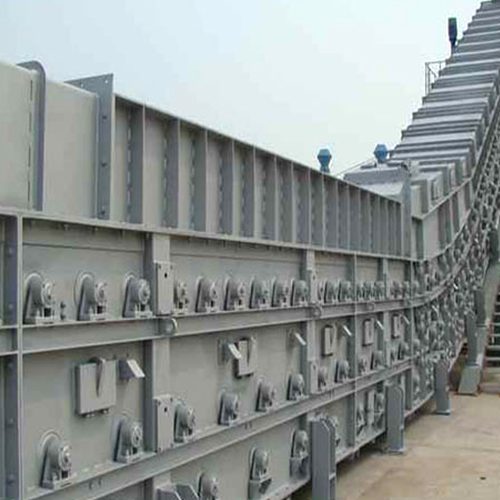
Sometimes, no flexible belt material can survive the environment. In these extreme cases, operations must pivot to metal.
Best for: Extreme conditions involving red-hot slag transported directly from the furnace. These systems handle sustained temperatures exceeding 1000°F.
Mechanism: This system abandons flexible rubber entirely. Instead, it uses overlapping manganese or heavy alloy steel pans mounted on robust industrial chains. The metallic pans absorb massive physical impacts and tolerate direct, open flames without warping.
Limitations: You cannot retrofit an apron onto a standard flexible belt frame. It requires a completely different, heavily reinforced conveyor structure. The capital expenditure is massive, and routine maintenance requires specialized millwright expertise rather than standard belt technicians.
Material Type | Max Continuous Heat | Impact Resistance | Ideal Application |
|---|---|---|---|
EPDM Rubber | 400°F (200°C) | Moderate | Semi-cooled slag, short runs |
Steel Cord | 350°F - 400°F | Very High | Heavy loads, long distances |
Aramid (Kevlar) | 400°F+ | High | Weight-restricted, high-impact zones |
Metallic Apron | 1000°F+ | Extreme | Furnace-direct, red-hot slag |
Selecting the right material requires precise, actionable data. You cannot guess the parameters or rely on outdated spec sheets. Let us explore how to match engineered materials to your daily process realities.
You must understand the exact heat distribution before specifying a belt. Ambient temperature, material temperature, and belt surface temperature represent three very different metrics. For example, slag might leave a furnace at 1200°F. However, if it travels on a vibrating feeder and cools before hitting the belt, the actual surface temperature upon impact might only reach 350°F. Use infrared thermal mapping tools to measure the exact temperature precisely at the loading zone. This empirical data prevents you from over-specifying the material.
Engineers often assume thicker covers are always better. This is a common and dangerous mistake in hot applications. A thick top cover certainly absorbs heavy mechanical impacts from jagged slag. However, rubber inherently acts as a thermal insulator. A cover that is too thick will trap core heat inside the carcass. This trapped heat accelerates internal degradation and ply separation. You must carefully balance the need for impact absorption against the crucial need for heat dissipation.
Stronger belts are naturally stiffer. Steel cord belts offer incredible tensile strength, but they require significantly larger pulley diameters to operate smoothly. If you install a rigid, high-tension belt on an older system with small pulleys, the aggressive bending stress will fracture the internal splices quickly. You must evaluate the tradeoff between maximum carcass strength and the physical, dimensional constraints of your existing drive system.
Handling hot materials introduces severe fire risks to your facility. Your chosen material must meet relevant industry safety standards. Depending on your specific sector, this might include strict MSHA or OSHA regulations regarding flame spread. Always look for belts officially certified for fire retardancy. Static conductivity is equally crucial. Moving heavy, dry materials generates massive static electricity, which can spark in dusty environments. Ensure the rubber compound is engineered to dissipate static charges safely into the grounded frame.
Even the highest-quality materials fail if you ignore implementation realities. Upgrading your belting introduces new mechanical variables to the plant. You must anticipate these operational shifts.
The splice is universally the weakest point of any conveyor system. Heat-resistant and steel cord materials require highly specialized hot vulcanized splicing. Mechanical fasteners (like traditional metal clips) frequently fail under extreme heat. The metal fasteners heat up much faster than the surrounding rubber, essentially burning the core fabric from the inside. Furthermore, heavy slag loads easily rip mechanical splices apart due to shear force. You must plan for longer installation downtimes to accommodate the complex hot vulcanization process.
Buyers often fall into two distinct financial traps. The first is "under-specifying." Buying cheap, standard rubber belts for high-heat zones creates a false economy. You will replace them repeatedly, suffering endless downtime and massive labor costs. The opposite extreme is "over-specifying." Purchasing a Tier-1 Aramid belt for a low-impact, fully water-cooled slag process wastes valuable capital. You must align the belt's specific capabilities strictly with your thermal mapping data to avoid unnecessary expenditures.
A heavier belt changes the fundamental physics of your conveyor. Upgrading from fabric to a steel-reinforced belt adds massive dead weight to the line. Your existing motors might lack the starting torque required to pull it. Gearboxes could overheat under the new, continuous strain. Idlers and rollers might fail prematurely due to the increased downward pressure. Always consult a mechanical engineer to ensure your drive system infrastructure can physically handle a heavier material structure.
Material choice drastically alters your routine maintenance schedule. Inspecting a standard rubber belt involves looking closely for thermal cracking and edge fraying. Conversely, inspecting a steel cord belt requires actively checking for moisture penetration. If water reaches the internal steel cords through a minor cover gouge, they will corrode, rust, and eventually snap under tension. You must adapt your facility's inspection routines to match the specific vulnerabilities of your new belt material.
Moving from technical evaluation to procurement requires a structured, logical approach. Follow these four definitive steps to secure the right solution for your plant.
Step 1: Conduct a Failure Analysis. Never buy a new belt without forensically auditing the outgoing one. Why did it fail? Did the top cover crack and harden from heat? Did it fail via delamination between the internal plies? Did a mechanical tear destroy the carcass? Identifying the exact failure mechanism dictates which specific material properties you must upgrade.
Step 2: Define the Operating Window. Document every single parameter of your conveying process. Measure the maximum lump size of the slag. Calculate the exact vertical drop height at the loading zone. Record the absolute peak temperature spikes. Note any chemical exposures from quenching water or sprays. Share this exact, comprehensive operating window with potential manufacturers.
Step 3: Vendor Vetting. Do not accept generic marketing brochures. Request specific, relevant case studies. Ask vendors to provide actual performance data from environments exactly like yours. Look for proven success in steel mills, foundries, or heavy mining operations. A vendor who only understands standard aggregate will likely struggle with the harsh realities of hot slag.
Step 4: Request a Lifecycle Projection. Move beyond the initial per-foot material price tag. Ask manufacturers to accurately model the expected lifecycle of the belt. Have them project necessary maintenance intervals and repair requirements based on your provided operating window. Understanding long-term durability helps you justify investing in high-grade materials like Aramid or specialized EPDM over commodity rubber.
Treat the Conveyor as an Engineered System: Surviving harsh slag conditions requires moving far away from commodity belting. Every single component must work seamlessly together to handle the daily abuse.
Balance the Variables: Correct material selection demands a careful, calculated balance. You must weigh thermal resistance against mechanical durability and your existing conveyor infrastructure constraints.
Understand the Failure Points: Never guess why a previous system failed. Use concrete data and thermal mapping to pinpoint vulnerabilities before buying replacements.
Take Action: Schedule a comprehensive site audit immediately. Consult directly with a conveying engineer to deeply analyze your specific load and temperature requirements before proceeding with any procurement decisions.
A: Standard rubber degrades quickly above 150°F. Specialized EPDM and chlorobutyl compounds handle continuous temperatures up to 400°F (200°C). They can survive brief, localized peak spikes around 500°F. However, if your material consistently exceeds these thresholds, rubber will fail rapidly. At temperatures approaching or exceeding 1000°F, you must abandon flexible belts entirely and utilize metallic pan conveyors.
A: This degradation stems from thermal oxidation. As intense heat continuously bakes the rubber, it draws out the essential plasticizers that provide flexibility. Once these chemical compounds evaporate, the rubber becomes rigid and brittle. As the belt bends tightly around pulleys, this brittleness causes deep transverse cracks across the top cover.
A: It depends entirely on your specific application. Steel cord offers unmatched tensile strength, making it ideal for exceptionally heavy loads and long-distance runs. However, Kevlar (Aramid) provides similar high tensile strength at a fraction of the weight. Kevlar puts less strain on drive motors and resists certain corrosive environments better than steel.
A: Given the extreme conditions, you should conduct visual inspections daily or weekly. Look for immediate signs of cover wear and structural tears. Perform deeper mechanical inspections monthly. Emphasize checking splice degradation, as splices are the most common failure points. Adjust this frequency based on your specific load severity and operating hours.

