
Views: 0 Author: Site Editor Publish Time: 2026-08-28 Origin: Site


Moving hot, highly abrasive slag represents a brutal operational reality. It remains one of the most punishing material handling applications in metallurgy and mining. Tight plant footprints frequently force engineers to utilize steep inclines. Existing infrastructure leaves little horizontal room for optimal conveying paths. However, aggressive incline angles severely compound your operational risks. They increase material rollback, accelerate rapid equipment wear, and invite catastrophic mechanical failures.
Standard off-the-shelf belts simply cannot survive these severe conditions. They melt, shred, or snap under extreme thermal and physical stress. You need a highly specialized approach to move this challenging material vertically. This article provides a technical framework for evaluating incline constraints effectively. We will examine layout geometries and structural requirements necessary for your facility.
You will learn how to specify a handling system accurately. We want to ensure your layout never bottlenecks daily production. We explore optimal angles of repose, specialized belting solutions, and crucial chute design principles. This knowledge helps you protect your workforce and maintain consistent plant throughput.
Incline Limits: Exceeding the natural angle of repose for slag (typically 15°–20° for standard smooth belts) requires transition to specialized cleats, sidewalls, or metallic pan structures.
Layout Geometry: Minimizing transfer points and drop heights is critical to reducing abrasive impact wear and dust generation.
Material-to-Equipment Match: A High Performance Slag Conveyor balances steep-angle space saving with heavy-duty heat and abrasion resistance.
Vendor Evaluation: Shortlist manufacturers based on their ability to customize drive sizing, tensioning, and chute design for high-density, unpredictable bulk materials.
Industrial plants often face severe spatial realities. Facilities grow organically over several decades of operation. This constant expansion leaves very little horizontal space for new material routes. You must navigate carefully around existing furnaces, crushers, and structural columns. Engineers must push incline limits to bridge these tight gaps successfully. You simply cannot bulldoze existing infrastructure to accommodate a gentle conveyor slope.
Unfortunately, standard off-the-shelf incline conveyors fail quickly in these environments. Slag carries extreme bulk density and intense residual heat. Standard rubber degrades rapidly under this constant thermal stress. Lightweight steel frames warp when subjected to heavy bulk loads repeatedly. You will experience constant belt tracking issues and bearing failures. Relying on generic equipment for this specialized task guarantees expensive downtime.
Success requires clearly defined operational criteria. We define a successful layout by several non-negotiable factors. First, it must deliver maximized throughput consistently without bottlenecking upstream processes. Second, it must guarantee zero material rollback during operation. Spilled slag creates severe safety hazards for your workforce and damages tail pulleys. Third, the framework must exhibit minimal structural vibration under heavy loads. Excessive shaking destroys bearings and misaligns your drive components. Finally, you must ensure safe, unobstructed access for maintenance personnel.
Understanding the natural angle of repose is absolutely vital. The physical state of your slag dictates the maximum safe incline angle. Granulated slag acts very differently than large crushed chunks. Wet material tends to stick and clump together readily. Dry slag rolls easily down steep slopes, creating runaway hazards. You must match your incline design to these exact physical states. If you ignore the angle of repose, gravity will inevitably overpower your friction.
Plant layouts demand different approaches based on required elevation changes. You have several distinct options for moving slag upward through a facility. Each choice balances spatial efficiency against capital expenditure and maintenance needs.
Standard trough belts work effectively up to approximately 15 degrees. They represent the most common layout choice for gentle slopes. They offer straightforward maintenance and lower initial installation costs. However, pushing past this 15-degree limit causes immediate problems. You will experience dangerous material rollback. Spillage accumulates quickly around the tail pulley and floor area. This requires constant manual cleanup from your already busy maintenance crew.
Cleated and corrugated sidewall belts handle much steeper angles efficiently. They become necessary for angles ranging from 20 degrees up to 90 degrees. These specialized belts trap the material securely in individual pockets. They prevent slag from tumbling backward during steep vertical transit. Because slag retains intense heat, you must specify heat-resistant rubber compounds. EPDM rubber offers excellent thermal stability for these precise applications. It prevents the cleats from melting, cracking, or detaching under load.
Steel pan or drag chain conveyors provide the definitive robust solution. They manage extremely hot, sharp slag on steep inclines safely. Metallic pans will not melt, tear, or stretch like rubber belts. They handle direct contact with glowing material directly from the furnace. The initial capital expenditure is notably higher for these steel systems. However, you benefit from a drastically lower operational wear rate. They outlast rubber belts by years in punishing, high-heat environments.
Conveyor Capability Matrix for Slag Handling
Conveyor System Profile | Maximum Safe Incline | Ideal Material Suitability | Thermal Resistance Level |
|---|---|---|---|
Standard Smooth Trough Belt | Up to 15 Degrees | Small granulated or uniform slag | Low to Moderate (Requires cooling) |
Cleated & Corrugated Sidewall | 20 to 90 Degrees | Medium to fine crushed bulk | High (Requires EPDM compounds) |
Metallic Pan / Drag Chain | Up to 60+ Degrees | Heavy, sharp, irregular chunks | Extreme (Handles direct hot slag) |
Drive and tensioning adjustments matter greatly for steep inclines. Gravity exerts massive downward force on loaded belts moving uphill. Steep inclines require significantly higher motor torque than flat runs. You need heavy-duty gearboxes to move these dense loads upward efficiently. Tensioning systems must respond dynamically to constant belt stretch. Furthermore, robust mechanical backstops are completely non-negotiable. These anti-runaway devices lock the system immediately during power failures. They prevent tons of heavy slag from crashing down the incline.
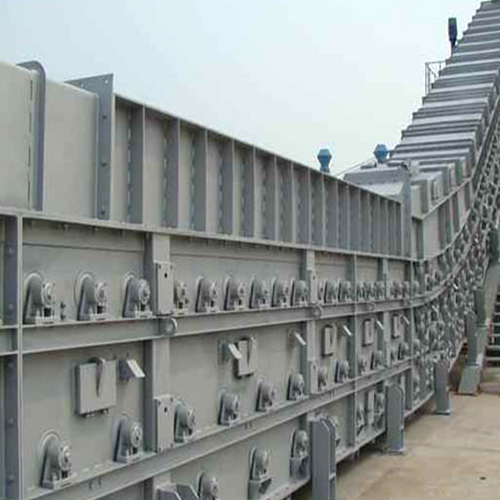
Layout planning must strongly prioritize loading and discharge zones. These impact zones take brutal physical punishment daily. A well-designed Slag Conveyor survives by mitigating these exact forces. Material transitions create the highest wear rates in any handling system. You must engineer these points carefully to prevent premature structural failure.
Drop height mitigation plays a massive role in system longevity. Lowering the drop height reduces impact damage significantly. It protects your belts and metallic pans from heavy gouging. Large chunks falling from great heights easily puncture standard rubber. Shorter drops also limit dangerous dust generation inside your facility. Slag dust often contains hazardous silica or metallic particles. Keeping drop heights minimal keeps this dust out of the breathable air. It protects your workers and prevents dust from contaminating nearby machinery bearings.
Chute design requires rigorous evaluation within constrained layouts. Tight spaces often force awkward, abrupt transition points between equipment. You must consider rock-box or dead-bed chutes for these areas. These designs allow slag to impact against a trapped layer of itself. This material-on-material friction saves your steel structures from direct hits. It prevents rapid abrasion of the external chute walls.
Alternatively, you should install heavy-duty steel liners. High-quality plates offer a tough defense layer against sharp edges. They extend chute life dramatically in confined, high-wear transition zones.
Utilize dead-bed designs to trap material and drastically reduce sliding wear.
Install AR400 or AR500 steel liners in high-impact transition zones.
Ensure inspection doors remain easily accessible for quick liner swaps.
Angle the discharge chute to match the receiving belt speed closely.
Install heavy-duty skirtboards to contain fugitive dust at the loading zone.
You must evaluate specific solution categories when specifying robust equipment. Thermal defenses represent the first major design requirement. You must evaluate heat-resistant ratings against your actual operational realities. Consider the exact cooling time before material hits the belt. If plant layouts are exceptionally short, the material travels faster. The slag may remain dangerously hot upon transfer. Your belt compound or steel pan must match these peak temperatures.
Structural rigidity prevents dangerous vibrations during continuous operation. Moving heavy slag up a steep incline creates dynamic stress. The supporting framework must handle shifting weight constantly. A true High Performance Slag Conveyor utilizes heavily reinforced, engineered trusses. Deep truss designs keep the entire system completely stable. They prevent swaying, twisting, or buckling under maximum load capacity. A rigid frame keeps idlers aligned and prevents belt tracking failures.
Accessibility often suffers greatly in tight plant layouts. You cannot ignore daily maintenance needs during the engineering design phase. A tight footprint should never prevent safe physical access. Technicians need ample room to reach idlers safely. They must access bearings, grease points, and drive components without obstruction. Walkways, platforms, and inspection doors must be integrated into the design. If maintenance is difficult, your team will likely skip it. This leads directly to premature equipment failure and massive production losses.
Choosing the right manufacturing partner mitigates your layout risks significantly. You must watch out for specific red flags in engineering proposals. Avoid vendors relying solely on generic bulk-material calculations. Slag has unique density characteristics and severe abrasion metrics. Generic formulas lead to undersized motors and weak frames. They result in inadequate tensioning and failing structural supports. Your chosen vendor must understand metallurgy, not just basic aggregate handling.
Integration risks also threaten your overall system reliability. You must account for upstream and downstream flow rates accurately. Ignoring these metrics causes disastrous bottlenecks across your plant. For example, crusher output surges can easily overload a steep incline. The equipment must handle peak surge loads safely and continuously. It cannot rely merely on average daily flow rates to survive.
Use this comprehensive vendor evaluation checklist to guide your final decision:
Do they offer custom 3D spatial scanning to prove layout viability?
Can they provide references for similar heavy-duty, high-heat material applications?
What are their standard warranties on wear parts under severe slag conditions?
Will they engineer specific drive packages tailored to high bulk density?
Do they conduct onsite physical audits before finalizing the incline geometry?
Are their belt tensioning systems designed for dynamic, heavy-load environments?
Forcing standard equipment into a steep, constrained slag application invites disaster. It will result in unplanned downtime and exceptionally high maintenance costs. You will spend excess capital constantly replacing shredded belts and warped frames. Instead, emphasize prioritizing specialized material construction from day one. Combine robust heat and abrasion resistance alongside the specific required incline angle.
Taking a proactive engineering approach guarantees long-term operational success. It protects your personnel while ensuring steady material flow. Here are the critical next steps for your facility:
Map your spatial constraints accurately using 3D scanning before requesting bids.
Specify construction materials based on actual peak operational temperatures, not averages.
Demand robust drive systems equipped with reliable, heavy-duty mechanical backstops.
Prioritize maintenance accessibility by demanding integrated walkways and inspection ports.
Promptly schedule an engineering site walk with a specialized vendor. Submit your facility layout drawings today for a custom capability assessment. Proper planning now prevents catastrophic mechanical failures in the future.
A: Typically 15-18 degrees for a smooth trough belt, depending on slag size and moisture. Steeper angles require cleats or pan conveyors.
A: Layouts must account for cooling time. If the layout is too short and fast, the slag may still be too hot for rubber belts, requiring a shift to steel pan conveyors.
A: Slag is heavy and often rounded (if granulated). Without proper cleats, sidewalls, or correct speed calculations, the material slips backward, causing spillage and belt wear.
A: Footprint depends on the required elevation change and material properties. Divide the elevation change by the tangent of the maximum safe incline angle to find the minimum horizontal run, then add space for tail/drive pulleys and transfer chutes.

